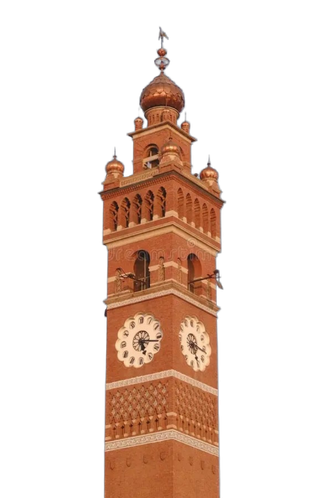

The Residency
The Residency still carries visible traces of the Siege of Lucknow in 1857. Its broken walls and preserved ruins make the history unusually physical: not reconstructed into neatness, but allowed to remain visible.

Lucknow · शहर
Lucknow has been written about through its buildings, its food and its manners.
But the city has also lived through words.
In poetry recited aloud, in newspapers printed and passed from hand to hand, in books published here and in the everyday precision with which language continues to be used.
Metaphor belongs to this Lucknow.
तहज़ीब · TEHZEEB
Tehzeeb is often reduced in translation to etiquette.
In Lucknow, the word carries something larger: an attention to language, to the person across from you and to the manner in which disagreement is held.
It does not ask conversation to be without conflict. It asks us to remember that form is part of meaning.
Metaphor takes that idea seriously.
The festival makes room for disagreement, but it also believes an argument can have grace without losing its force.
Three places, if you have a day
The Residency still carries visible traces of the Siege of Lucknow in 1857. Its broken walls and preserved ruins make the history unusually physical: not reconstructed into neatness, but allowed to remain visible.
Commissioned by Nawab Asaf-ud-Daula in 1784 during a period of famine, the Bara Imambara is closely tied to Lucknow's history of public works and relief.
Tradition holds that work continued in different shifts so employment could be sustained during the crisis.
Its vast central hall, built without conventional supporting beams, remains one of the complex's defining architectural feats.
Hazratganj even gave Lucknow a verb.
Ganjing: the leisurely business of walking through the market without much urgency and with no particular objection to being seen doing it.
Try it near dusk.

Chikankari
Chikankari is one of Lucknow's most recognisable craft traditions, built through the patience of hand embroidery and the rhythm created between thread and cloth.
The dividing lines used across this website borrow only that rhythm: stitch, space, stitch.
Not as decoration for its own sake, but as a quiet reference to the city the festival comes from.
On the tongue
Lucknow's literary life has long moved between Hindi and Urdu.
The two have distinct literary histories, but in this city they have repeatedly met in poetry, theatre, journalism, music and speech.
At Metaphor, Hindi and Urdu share the stage with English, and speakers move between them when the thought demands it.
Language here is not an exhibit.
It is still in use.
November
Late November is one of the most pleasant times to be in Lucknow.
Mornings and evenings are cooler, while the afternoons are usually comfortable enough to spend outside. It is the kind of weather that allows a conversation to leave the hall and continue in the courtyard.
Bring a light layer for the evening.